Van wie was Emma Goldman?
Alexander Berkman dateerde van Emma Goldman van ? tot ?. Het leeftijdsverschil was 1 jaar, 4 maanden en 25 dagen.
Emma Goldman
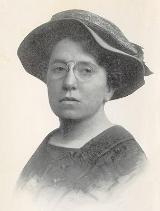
Emma Goldman (June 27, 1869 – May 14, 1940) was a Russian-born anarchist revolutionary, political activist, and writer. She played a pivotal role in the development of anarchist political philosophy in North America and Europe in the first half of the 20th century.
Born in Kaunas, Lithuania (then within the Russian Empire), to a Lithuanian Jewish family, Goldman immigrated to the United States in 1885. Attracted to anarchism after the Haymarket affair in Chicago, Goldman became a writer and a renowned lecturer on anarchist philosophy, women's rights, and social issues, attracting crowds of thousands. She and anarchist writer Alexander Berkman, her lover and lifelong friend, planned to assassinate industrialist and financier Henry Clay Frick as an act of propaganda of the deed. Frick survived the attempt on his life in 1892, and Berkman was sentenced to 22 years in prison. Goldman was imprisoned several times in the years that followed, for "inciting to riot" and illegally distributing information about birth control. In 1906, Goldman founded the anarchist journal Mother Earth.
In 1917, Goldman and Berkman were sentenced to two years in jail for conspiring to "induce persons not to register" for the newly instated draft. After their release from prison, they were arrested—along with 248 others—in the so-called Palmer Raids during the First Red Scare and deported to Russia in December 1919. Initially supportive of that country's October Revolution that brought the Bolsheviks to power, Goldman changed her opinion in the wake of the Kronstadt rebellion; she denounced the Soviet Union for its violent repression of independent voices. She left the Soviet Union and in 1923 published a book about her experiences, My Disillusionment in Russia. While living in England, Canada, and France, she wrote an autobiography called Living My Life. It was published in two volumes, in 1931 and 1935. After the outbreak of the Spanish Civil War, Goldman traveled to Spain to support the anarchist revolution there. She died in Toronto, Ontario, Canada, in 1940, aged 70.
During her life, Goldman was lionized as a freethinking "rebel woman" by admirers, and denounced by detractors as an advocate of politically motivated murder and violent revolution. Her writing and lectures spanned a wide variety of issues, including prisons, atheism, freedom of speech, militarism, capitalism, marriage, free love, and homosexuality. Although she distanced herself from first-wave feminism and its efforts toward women's suffrage, she developed new ways of incorporating gender politics into anarchism. After decades of obscurity, Goldman gained iconic status in the 1970s by a revival of interest in her life, when feminist and anarchist scholars rekindled popular interest.
Lees meer...Alexander Berkman

Alexander Berkman (Russisch: Александр Беркман), geboren als Ovsej Ossipovitsj Berkman (Russisch: Овсей Осипович Беркман), (Vilnius, 21 november 1870 - Nice, 28 juni 1936) was een in Litouwen geboren activist. Hij emigreerde in 1887 naar de Verenigde Staten. Daar werd hij actief in de anarchistische beweging. Hier ontmoette hij Emma Goldman (1869-1940), met wie hij zijn leven lang bevriend bleef.
Als Berkman op 6 juli 1892 hoort dat een aantal stakers in de staalindustrie door toedoen van de Pinkerton ‘detectives’ (een particulier beveiligingsbedrijf) de dood heeft gevonden, besluit hij tot een wraakactie. Hij zoekt dan op 22 juli 1892 het hoofd op van de Carnegie Steel Company, H.C. Frick. In diens kantoor vuurt hij enkele revolverkogels op hem af. Deze verwonden Frick slechts. Berkman wordt voor zijn daad tot 22 jaar gevangenisstraf veroordeeld, waarvan hij er uiteindelijk veertien uitzit.
Wegens antimilitaristische propaganda komt hij later nogmaals voor twee jaar in de gevangenis (1917-1919). Na zijn ontslag daaruit wordt hij, onder meer samen met Emma Goldman, naar Rusland gedeporteerd. Na aldaar twee jaren te hebben verbleven, verlaten zij in 1921 opnieuw hun geboorteland, omdat in hun ogen de bolsjewistische reactie de revolutie heeft gesmoord.
Als balling buiten Rusland schrijft Berkman onder meer het boek Now and After: The ABC of Communist Anarchism. Berooid, ziek, in het zuiden van Frankrijk levend als een politieke vluchteling, beneemt hij zich in 1936 het leven.
Lees meer...