Van wie was Jean Marais?
Jean Cocteau dateerde van Jean Marais van tot . Het leeftijdsverschil was 24 jaar, 5 maanden en 6 dagen.
Jean Marais

Jean Marais (Cherbourg, Manche, 11 december 1913 - Cannes, Alpes-Maritimes, 8 november 1998) was een Frans acteur. Zijn echte naam was Jean Alfred Villain-Marais, terwijl zijn partner en zeer goede vriend Jean Cocteau hem Jeannot noemde.
Waarschijnlijk heeft hij zijn meer dan zestig jaar durende carrière onder meer aan Jean Cocteau te danken. De schrijver en filmregisseur werd al vroeg zijn mentor. Marais' blonde, klassieke uiterlijk en het goede acteren werd uiteindelijk gezien in meer dan zeventig films, talrijke toneelstukken en televisieprogramma's. Marais was een van de meest gevierde sterren van de Franse films, het theater en de televisie.
Lees meer...Jean Cocteau
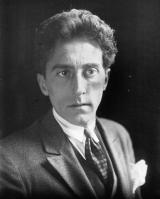
Jean Maurice Eugène Clément Cocteau (UK: KOK-toh, US: kok-TOH; French: [ʒɑ̃ mɔʁis øʒɛn klemɑ̃ kɔkto]; 5 July 1889 – 11 October 1963) was a French poet, playwright, novelist, designer, film director, visual artist and critic. He was one of the foremost avant-garde artists of the 20th century and highly influential on the Surrealist and Dadaist movements, among others. The National Observer suggested that "of the artistic generation whose daring gave birth to Twentieth Century Art, Cocteau came closest to being a Renaissance man".
He is most notable for his novels Le Grand Écart (1923), Le Livre blanc (1928), and Les Enfants Terribles (1929); the stage plays La Voix Humaine (1930), La Machine Infernale (1934), Les Parents terribles (1938), La Machine à écrire (1941), and L'Aigle à deux têtes (1946); and the films The Blood of a Poet (1930), Les Parents Terribles (1948), Beauty and the Beast (1946), Orpheus (1950), and Testament of Orpheus (1960), which alongside Blood of a Poet and Orpheus constitute the so-called Orphic Trilogy. He was described as "one of [the] avant-garde's most successful and influential filmmakers" by AllMovie. Cocteau, according to Annette Insdorf, "left behind a body of work unequalled for its variety of artistic expression".
Though his body of work encompassed many different media, Cocteau insisted on calling himself a poet, classifying the great variety of his works — poems, novels, plays, essays, drawings, films — as poésie, poésie de roman, poésie de thêatre, poésie critique, poésie graphique and poésie cinématographique.
Lees meer...